

When we think of driving revenue, most people think of sales.
But the sales-led playbook relies heavily on cold email, a channel whose effectiveness is plummeting.
| Year | Reply rate | Status |
|---|---|---|
| 2014 | 8% | Supplied value |
| 2019 | 4% | Supplied value |
| 2024 | 1.5% | Supplied value |
| 2029 | ≈0.25% | Approximate projection |
Sending more cold emails won’t solve the underlying problem: startups need to build demand. We’ve witnessed this problem firsthand: companies scale their sales team without building the awareness, trust and interest needed to make buyers want their product.
68% of B2B buyers already have a preferred vendor before entering a formal buying process. They’re researching with AI agents, visiting websites, clicking Google Ads, attending events and reading emails. Much of the work of winning customers happens before a sales conversation begins.
We believe the next generation of B2B companies will be marketing-led: building awareness and trust, nurturing interest and turning it into revenue.
We’re building Percolate, an agentic marketing platform for B2B companies, to take on that labor. Percolate will bring customer data, company context and campaign execution into one system, so it can run campaigns across channels and learn from their outcomes.
We’ve both lived this problem

Syl was the rare marketer who rose to lead revenue at developer startup Pusher (most CROs come from sales). He was the founding GTM hire at Census, where he built the sales, marketing, and revops teams, and went on to be VP of Growth at Augment Code, the enterprise context engine company. He's built the operational customer data model at all these companies, and advises several startups on their growth.

Roslyn was the founding product manager at Okera, a technical data product acquired by Databricks, and then went on to be a founding product marketer at Census and Together AI. She built the marketing team’s context layer at Augment Code.
We worked together at Census and Augment Code and bonded because we're both generalists who can build. We're experienced startup operators with a strong sense of taste, and we're highly opinionated about the product B2B marketers need and how to reach them.
Marketing teams buy automation, then pay people to connect the data
Building demand takes more than a single interaction. Someone attends an event, explores a product page and needs more information before they’re ready to buy. Marketers have to connect those interactions and decide what to do next.
The first tool a Head of Marketing at a B2B startup buys is the Marketing Automation Platform, or MAP. A MAP can send emails, build audiences and track campaigns, but it needs someone to tell it who to reach and what to do. Between us, we’ve used or purchased almost every major one: HubSpot, Customer.io, Marketo and Pardot.
The customer data needed to actually make those decisions lives elsewhere: in the CRM, website analytics, product analytics, enrichment tools, event platforms, ad platforms and data warehouses. Buying a MAP doesn’t bring that data together.
We saw this first hand with hundreds of customers at Census, a reverse-ETL tool. At Census we worked with marketing teams at Figma, Canva, and Notion to sync customer data from their data warehouses (like Snowflake and Databricks) into their marketing and sales systems. These teams already had a MAP, but they needed a data team and separate product to run the campaigns they wanted.
Other companies hire marketing operations people or agencies to connect the systems. Now “GTM engineers” are using AI to do parts of that work faster. We think that misses the point: marketers shouldn’t need to build and maintain the system that lets them do their jobs.
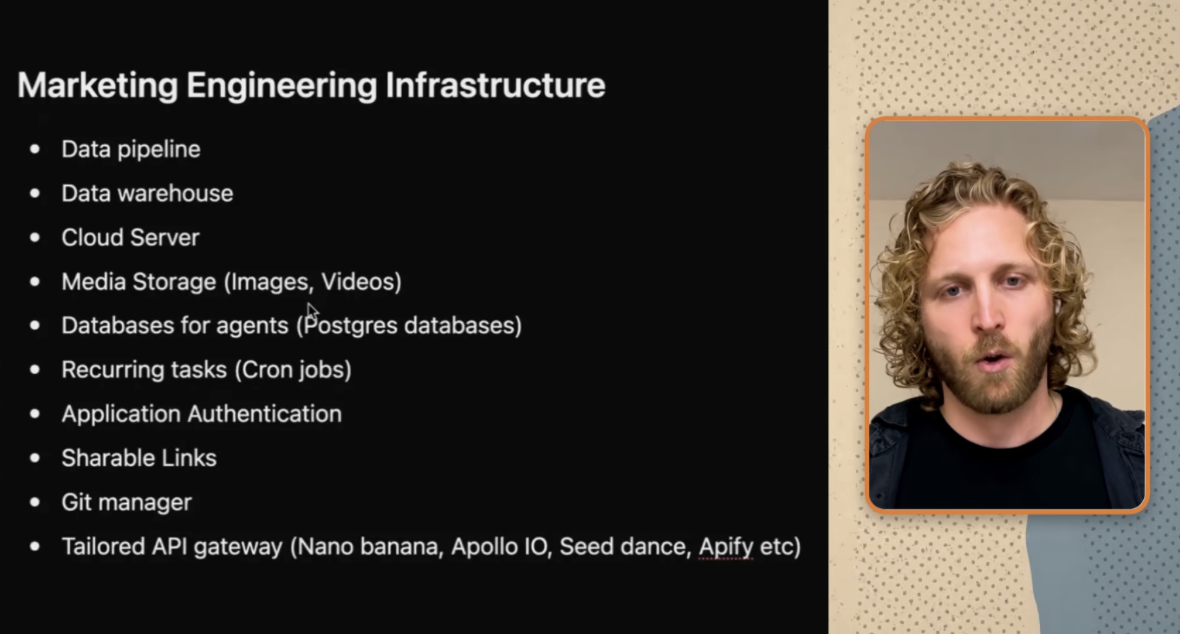
AI agents make data and context even more critical
On the other side, AI has dramatically reduced the cost of marketing execution (i.e. you can draft an email in seconds), making that data and context more important than ever. AI agents still need to know who should receive those emails, what message matters to them and your company’s tone of voice guidelines.
Tech forward marketing teams are building these “context layers” inside Github so that they can use them inside general harnesses like Claude and Codex. We built this ourselves at Augment, and although more efficient than before, we still were limited by not having all the customer data available (i.e. if it wasn’t in the data warehouse, we couldn’t use it). We also found the experience of maintaining this context layer extremely brittle, and we didn’t see adoption by the more non-technical marketers on the team, for example field marketers.
That led us to a bigger question: what if the marketing platform already had the customer data and company context, and could execute the work itself?
What a campaign looks like in Percolate
Consider a marketer who has just run an event through Luma. Today, they might export attendees into a csv and re-import that into the MAP, divide the list into segments and write follow-up emails.
Percolate will bring in those attendees, enrich their records and match them with existing customer information. It will propose different follow-up for different audiences: a relevant customer story for prospects evaluating the product, or an invitation to a practical workshop for people still exploring the problem.
The marketer will review the audiences and messages, then approve the campaign. Responses will feed back into the customer record to inform what happens next.
A single platform for marketing teams
We’ll build Percolate in three parts:

Action
Agents will execute. Marketers will direct the work.
- Ads
- Webinars
- Landing pages
- Audience building
- Lead collection
- Scoring
- Attribution

Customer Data
High-quality, complete customer data. Continuously updated.
CRM, enrichment, sales calls, events, ad platforms, and your data warehouse
Company Context
Current, relevant context about your company and goals.
Positioning, messaging, audiences, and brand guidelinesNew first-party data
enriches customer records.
New insights
inform context updates for human review.
The data layer will assemble a rich, continuously updated customer record, with native integrations to CRM, enrichment providers, sales call platforms, event platforms, ad platforms and the data warehouse. No data team required.
The context layer will hold positioning, messaging, ICP definitions, and brand guidelines. These will inform which audiences Percolate proposes and how it writes each campaign.
The action layer will execute ads, webinars, email, landing pages, audience building, lead collection, scoring, and attribution. The platform will provide the integrations and systems needed to execute these actions reliably. Marketers will direct and review the work. Actions will generate new first-party data for the customer record and insights that can inform context updates. Agents will propose those updates, with humans as the final custodians.
Actions are cheap and easy to build. But actions without high-quality, complete data and current, relevant context are meaningless. Data and context are the foundations of the platform. The work will generate evidence that helps us keep those foundations useful.
Legacy MAPs were designed around people manually building campaigns and workflows. We’re designing Percolate around agents doing that work from the start.
We’ll start with a company’s first marketing hire
We’ll target Series A B2B companies hiring their first marketing lead and choosing their first marketing platform. We’ll start by connecting customer data from different sources and preparing relevant email nurture campaigns after events or filling out forms, with far less manual work.
Once we’ve proven that experience, we’ll expand to companies switching platforms from existing MAPs. Our goal is to give B2B marketers the channels they need in a single system, for example emails, ads, landing pages, webinars etc but we’ll start with emails and let customers prioritize which actions we add next.
Teaching the next generation of companies to be marketing-led
Buying marketing software alone doesn’t teach a company how to build demand. For example, there are companies that run regular events but never follow up with attendees. They’ve earned some attention, but not capitalized on it.
Through our own content, events and community, we’ll teach founders and early marketers what it means to be marketing-led, and demonstrate it through how we grow Percolate.
We’ll pair early customers with a forward deployed marketing expert who helps define audiences, sharpen messaging and launch programs, with Percolate doing an increasing share of the execution. Customers will get our marketing judgment through both the product and the people helping them use it. Working alongside them will reveal which decisions and workflows to build into the platform.
HubSpot won by educating the first generation of B2B SaaS companies about inbound marketing in the internet era. We will win by driving demand for the next generation of B2B companies in the marketing-led era.
We’ll capture software spend, marketing labor and revenue outcomes
B2B marketing automation is an established $7B software category. Companies also pay the people and agencies needed to operate it.
Percolate will replace the MAP and take on an increasing share of that labor. Customers can pay more for Percolate while spending less overall to run marketing.
We also believe Percolate can help them grow faster. By running more relevant campaigns, consistently following up on interest and learning what works, Percolate can build more demand and help turn it into revenue. That gives us room to capture more value as we prove the growth we deliver.
Self improving demand automation
As Percolate runs campaigns across different channels, it will learn which audiences and messages lead to sales conversations and revenue. For example, imagine launching 5 different landing pages and ad campaigns on various use cases for your product to test signal. Based on the winning use case you run a webinar, with an email nurture sequence. After a few months, you will have the data to know if that use case drives meaningful demand.
Eventually, a company will give Percolate a growth target and a budget. Percolate will plan, run and improve the programs, freeing marketers from the tyranny of operations and giving them more time for creative work and human experiences.
That’s self-improving demand automation. Our ambition is to run marketing for the next generation of B2B companies and be paid for the growth we deliver.